
Legal status
Canadian not-for-profit, incorporated May 13, 2026
Institutional and policy work runs through Orieth Institute. Corporate particulars are published on the site.
An acceptable response on its own does not establish safety across a series of conversations. Orieth Institute studies the risk that can form on the user side.
This site states what exists now, what is still unvalidated, and how the public record can be checked.
Institutional and policy work runs through Orieth Institute. Corporate particulars are published on the site.
Public materials are available in both languages, and current working materials are drafted across both when the record supports it.
The publication system distinguishes between current research outputs, supporting archival records, and predecessor work.
The Institute does not claim peer review, ethics-board authority, clinical service, legal opinion, or certification it does not have.
One line studies user-side contextual risk in long-term interaction. The second studies how a deployed AI product should govern change after launch.
A-CSM turns the Institute's contextual frameworks into a traceable research prototype for reviewing conversation records and packaging evidence.
Read this lineThe governance line treats the deployment configuration as the unit, grades updates by risk-bearing change, and records decision authority at the governance layer.
Read this lineThe current research record includes the August 4, 2026 Zenodo deposit on update grading and governance decision records, the USCP English and Traditional Chinese public editions, and the earlier framework lineage.
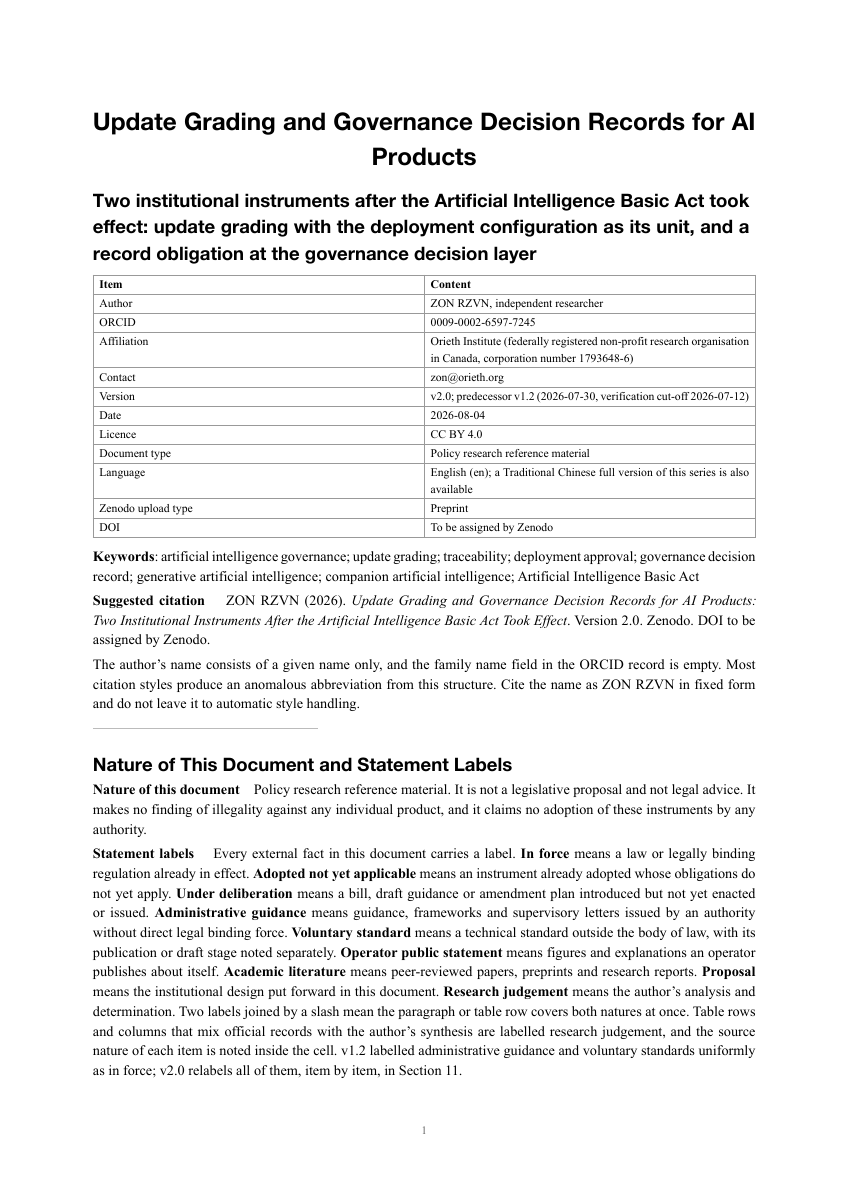
A bilingual Zenodo preprint on update grading, product drift, and governance decision records after Taiwan's Artificial Intelligence Basic Act took effect.
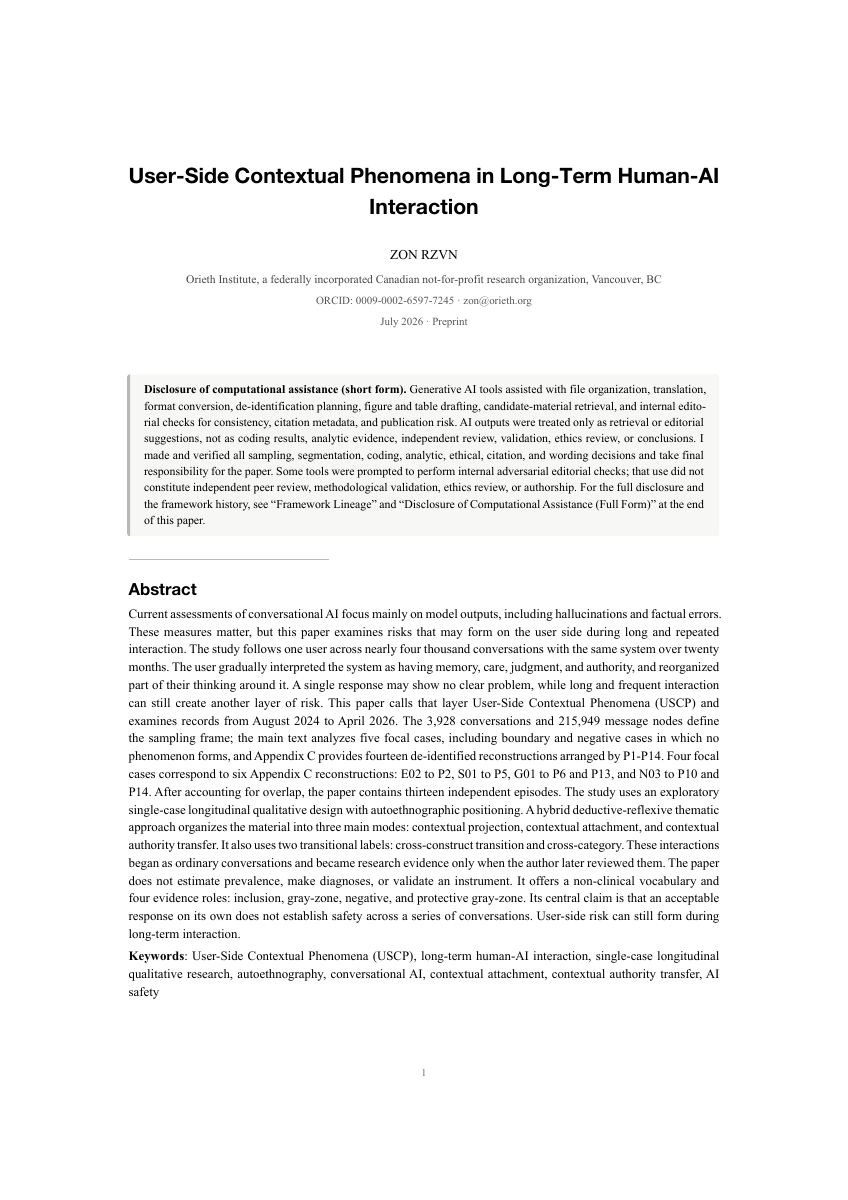
The principal English USCP preprint on long-horizon user-side contextual risk in conversational AI.
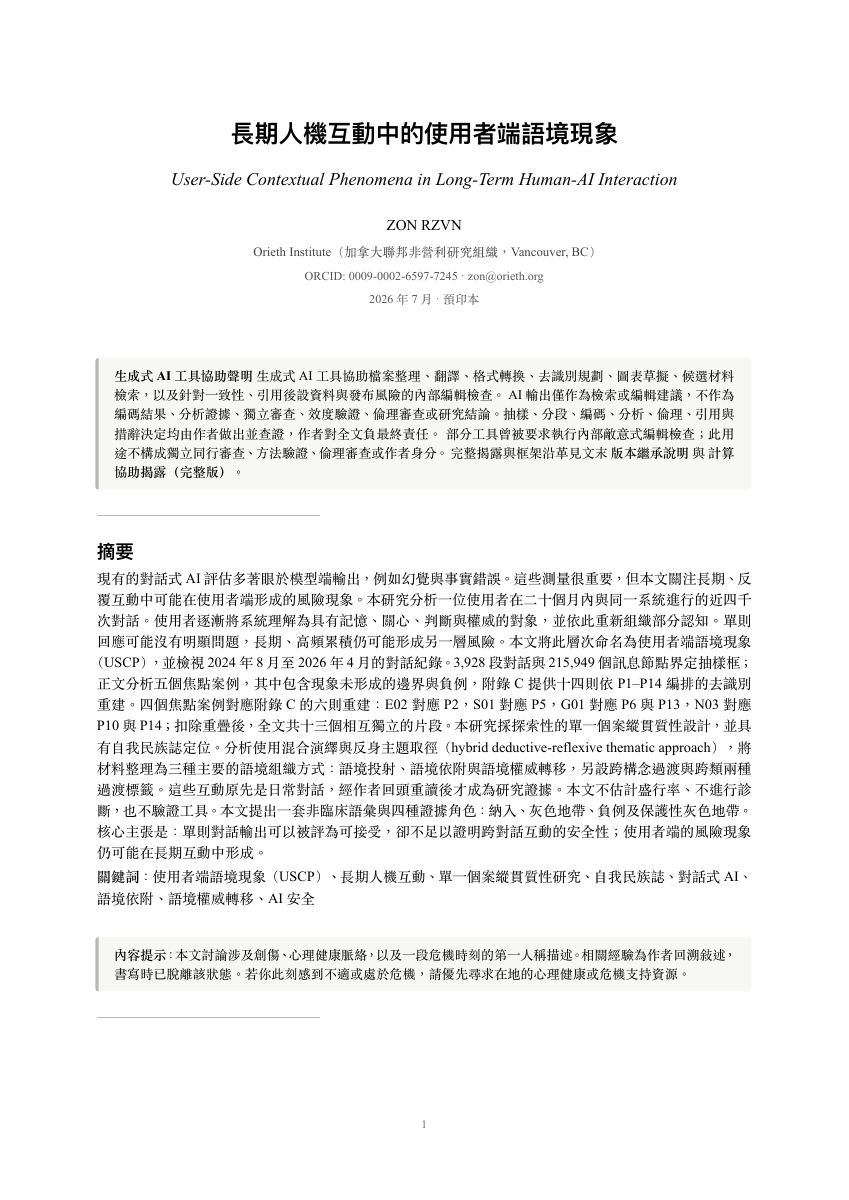
The Traditional Chinese public Zenodo edition of the USCP study.
The Institute works best with research partners, policy teams, and public-interest programs that need a careful method, explicit evidence ceilings, and bilingual written outputs.
Does the coding frame transfer to a corpus that does not come from inside the Institute?
A transfer report that states which labels hold, which collapse, and what must be rewritten before broader use.
What does the lifecycle and update-grading model produce when it runs against a named deployment?
A bilingual procedural review that grades changes, records gaps, and states its evidence limits directly.
How can update grading and governance decision records fit one jurisdiction's administrative machinery without overstating their evidence?
A draftable policy instrument package that keeps status labels and evidence ceilings explicit.
Trust comes from naming the ceiling. The public site keeps governance status, review status, and evidence status separate.

Use the institutional channel for research collaboration, publication questions, policy correspondence, and governance briefings.
Contact the Institute